Every climate founder knows how to tell the story.
The technology could transform an industry. The market is enormous. Costs will fall with scale. Customers are waiting. The next round will unlock the next phase.
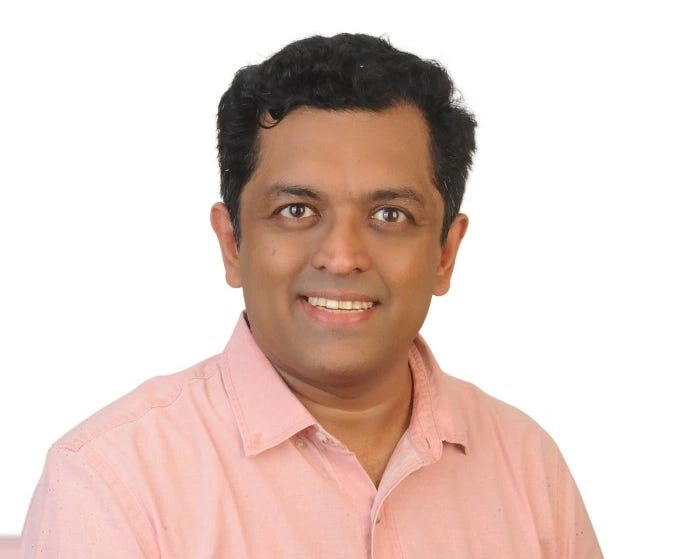
Abijit Aji has built his career around understanding a crucial question: How much of that future can you actually finance today?
As VP of Treasury & Financing at Gradiant, Aji has led more than $100 million of non-dilutive credit capacity, including a $50 million HSBC facility. Before that, at Reliance Power, he worked on structured capital for power-sector assets, raising financing from banks and development finance institutions.
He’s also spent time much closer to the technology development side itself, including at 8 Rivers Capital.
This experience has left him with a slightly different view of the capital problem facing climate tech. His diagnosis is what he calls the “story–reality delta”: the distance between the future a founder is describing and the present they can actually prove. At seed, a big delta is normal. There’s not much else to finance. But as a company matures, the gap is supposed to close. And when it doesn’t, the capital structure starts to break.
He thinks cleantech is especially exposed, because it’s capex-heavy, and because its founders are engineers whose instinct is to describe constraints to people who came to buy momentum.
Debt quietly became a quarter of all climate tech funding in the first half of 2026, up from a rounding error a few years ago, as the sector matured toward infrastructure and manufacturing capacity that equity alone can’t carry. Meanwhile the “missing middle” – the gap between a working prototype and the first commercial-scale deployment – keeps widening: Series B deals are down 29% this year, and the deals that do close are 28% smaller.
That gap hits hardware climate companies hardest, because most can’t reach first revenue without building a physical plant or fleet, and equity investors alone are rarely willing to fund that.
For climate founders – particularly those building hardware, infrastructure and industrial systems – Aji thinks the answer isn’t simply to get better at raising equity.
It’s to stop asking equity to finance everything.
We asked him what that looks like from inside the room.
You went from chemical engineering to an MBA in energy policy at columbia. what pulled you toward capital?
You can’t solve climate change from a lab.
The technology exists. The problem is getting it to market and connecting it to capital.
Chemical engineering gave me process thinking, which transfers well to finance. At 3M and then Tata Energy Research, I was in techno-commercial roles, but I kept seeing the commercial side decide the outcome.
That’s what pushed me toward the MBA; international financing runs on policy, geopolitics, macroeconomics and regulation. You need to understand all of those if you’re going to structure capital around infrastructure.
Was there a formative moment that shaped how you think about money and risk?
My father was an entrepreneur, which was unusual in our family. We’re a community where people generally get educated and take salaried jobs.
He shaped both me and my sister to think that you could build something instead.
I don’t avoid risk. What I’ve built is the ability to see it, manage it, monitor it and monetise it.
When you’re not structuring transactions, what do you do to unwind?
I read non-fiction, mental models, evolution and philosophy. Water helps me unwind – swimming and scuba diving were traditionally the ways I would do that. These days it’s more reading or chess.
When did you first realise debt could do something equity couldn’t for scaling cleantech?
At Reliance Power, even with a large public equity raise behind us, equity was never simply thrown at a problem. It’s the most expensive capital there is.
The discipline was: don’t go to the parent for money. If the idea is good, take it to the market. The venture world ran on almost the opposite logic – round to round, valuation to valuation. Putting those two approaches next to each other made me realise that climate tech had never really engaged with the rest of the capital stack.
That’s the central problem Aji sees: climate founders often think about capital as a sequence of fundraising rounds, rather than as a stack where different forms of money do different jobs.
What’s the biggest mistake founders make when they think “raising capital” only means “raising equity”?
They force-fit a venture template onto deep tech – an ARR or software model applied to technologies that take years to scale.
That puts them in the wrong capital structure, and they either raise too much and fail, or too little and struggle.
How “fundable” does a company need to look before a bank will talk to you?
I believe money goes where the opportunity is.
“Lookability” isn’t how I look at things.
Build the company on a business trajectory and money will meet it. Don’t have anything, don’t story anything. Build consciously and patiently.
You’ve described this as the “story–reality delta”. What do you mean?
At seed, the delta is enormous and nobody minds because there’s nothing else to buy.
You’re selling a future. As the company matures, reality is supposed to close that gap. You should have more data, more customers, more contracts, more assets and more evidence. When the gap stops closing, companies implode.
Not necessarily because the original story was wrong, but because nobody was watching the distance between the story and reality. Climate tech is particularly exposed because it’s capital-intensive, and because many of its founders are engineers. Their instinct is often to describe the technical constraints to people who came to buy momentum.
Take me inside the room for the first institutional lending facility at Gradiant. were you nervous?
No.
Most of the work in a first institutional facility is understanding who’s across the table.
A large bank has no reason to put significant effort into a small transaction, so the choice of counterparty matters. Once you’ve chosen well, both sides want to get it done.
Then you work out their drivers: who funds them, what their guardrails are, what their constraints are, and how you shape the opportunity to fit.
You’re usually running three or four structures with three or four parties at once, because every set of guardrails is different.
What does “unsecured surety and bank guarantee capacity” mean?
If you’re putting hardware on the ground, the customer often wants a guarantee before signing. Most startups respond by tying up cash to provide it. There are two routes.
Banks are constrained by regulation and mostly write these at the corporate level. Sureties underwrite based on project performance and track record, so they can go project by project. The advantage is that it sits as an unsecured line. You indemnify the surety, but it’s not a contingent liability sitting on the balance sheet in the same way.
What assets or contracts can an early-stage company leverage that founders don’t realise are leverageable?
Data.
Pilot data is an asset. It’s evidence to a different class of investor that the technology is financeable.
IP and cash, you leave alone. The IP is the foundation of the company and you need the cash to operate.
Beyond that, contracts.
A pilot contract or a first-of-its-kind contract can be bankable.
So if a founder has just completed a successful pilot, are you saying the pilot itself can start changing their capital options?
Exactly.
The pilot is evidence.
Once you’ve demonstrated that the technology works, the conversation changes from “does this work?” to “what contract does this generate, and what does it take to perform that contract?”
That’s a completely different financing conversation.
You once saw an engineering company arrive at a project negotiation with its financier already attached. What did that teach you?
The proposal was effectively: pick me, and the money comes with me.
I’d never seen an engineering firm arrive with its financier – JICA – and say that if they won the project, the financing came with it.
That made the decision easy for the counterparty to partner. I still recommend that approach. It works because the lender has already vetted you.
In other words: don’t just sell the customer the technology. Remove the financing problem from their list of reasons to say no.
What do equity investors misunderstand about founders who pursue debt or structured capital instead of simply raising a bigger equity round?
They don’t misunderstand the founders. They misunderstand debt.
They still read it as old-school capital.
Debt makes you deliberate about everything, and deliberate is slower. That’s what VCs dislike, because it doesn’t fit the clock their time exits on.
What they’re missing is how cleantech is supposed to grow.
What makes a climate-tech company investable to a lender in a way that’s fundamentally different from what makes it investable to a VC?
Assets.
Equity looks at IP, the team, market size, maybe some early numbers.
Debt weighs assets at least as heavily.
Generate them, demonstrate them, and you’re worth a lender’s time.
What would you tell a founder raising to do in month one – before they’ve even built a pitch deck?
Learn how contracts get negotiated and signed. A short course on the bankability of contracts would do it. There’s plenty more, but for climate tech that’s first.
What does a founder give up by taking debt instead of equity – and when is that trade-off worth it?
Speed and risk.
Debt forces you to be deliberate about everything, which slows you down, and you carry more risk. But taking on debt signals confidence and maturity in the business. And what you gain can outweigh it: far less dilution, and a real EBITDA kicker.
What’s the most common mistake you see founders make when they finally approach a lender?
They treat venture debt as equity in a different wrapper.
Your first debt should be contract-based, factoring, something anchored to a receivable, rather than venture debt sitting on the balance sheet.
The mistake isn’t taking debt. It’s taking the wrong type.
If a founder had 60 seconds to pitch a lender instead of a VC, what should those 60 seconds sound like?
We built this product from scratch and we own the IP, demonstrated through pilots. We took that pilot to a customer, they agreed the data held up, and they gave us this contract. Performing on it needs X dollars, and we’re asking you for 0.7X, on terms that mirror the contract’s duration and profitability.
That’s a very different pitch from “we’re raising £5 million to scale”.
Exactly. You’re not asking the lender to believe the entire story. You’re asking them to finance the part of the story that’s already becoming reality.
Rapid-fire
Mantra you keep coming back to in a high-stakes negotiation?
“If you want to make apple pie from scratch, you must first invent the universe.” -Carl Sagan.
A habit or ritual that keeps you sharp through a big deal?
Perseverance.
Favourite quote?
“When you do good to someone, it never comes back from the same person, but it comes back.” Or: “Reality is different for different people.”
What keeps you optimistic about the future?
People. We create problems for ourselves and then work our way out of them. That cycle doesn’t stop.
A book recommendation for climate founders?
Creating Climate Wealth by Jigar Shah.
The Hard Thing About Hard Things by Ben Horowitz.
Meditations if you want something more philosophical.
The 48 Laws of Power if power is what you’re studying.
For systems thinking, Kahneman and Taleb.
Ten years from now, does “raising capital” for a climate-tech founder still default to equity-first?
It’s already changing, and fast, because equity has become scarce. Grants and other non-dilutive capital are now part of the mix, and the boundaries between capital types keep dissolving. Venture debt was an attempt at that, but it was never a true blend. Where this goes is a merging of the capital stack – horses for courses.
What’s your role in making that shift happen?
Bringing later-stage infrastructure experience into early-stage innovation:
How you pitch the customer.
How you build the contract.
How you secure the capital provider.
Wrapped in a solutions approach.